 By Vikas Thori · Updated 20 November 2026
If you listen to an ambulance or police car crossing a city, you will often hear the sound change several times in a minute: a long rising and falling note on the open road, a fast warble near a junction, sometimes a deep rumble or a short blast of an air horn. Those are not random. Modern electronic sirens offer a small set of tone patterns, and the person driving picks between them with a switch or a button on the horn ring.
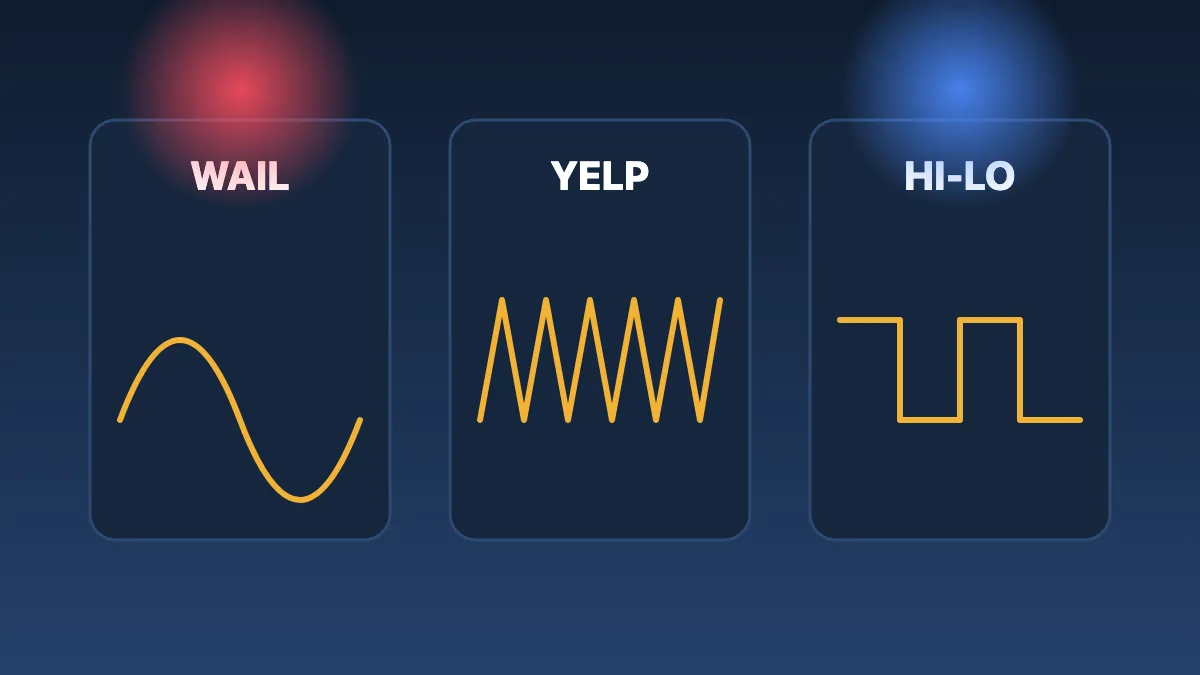
Below is each common pattern, with a diagram of how its pitch moves and a button to hear the version this site generates.
Mechanical and electronic sirens
The first vehicle sirens were mechanical: a motor spins a slotted rotor inside a slotted housing, chopping a stream of air into pulses. The faster it spins, the higher the note, so a mechanical siren naturally winds up and down. Many fire engines still carry one because it is very loud and has a distinctive sound.
Most police cars and ambulances today use an electronic siren instead: an amplifier drives a horn-shaped speaker, and a small tone generator decides what it plays. Because the tone is made electronically, one box can produce several patterns. Manufacturers give them slightly different names, but the main ones are the same across the industry.
Wail
The wail is a slow sweep up and down, copying the sound of a mechanical siren winding up and slowing down. One manufacturer's specification sheet, for example, describes its wail as sweeping between roughly 560 and 1,055 hertz at about 11 cycles per minute; other models are a little faster or higher. The slow change makes it carry well over distance, so it is the usual choice on open roads and long straight stretches.
The weakness of the wail is that it is predictable. After a few seconds, people inside cars tend to stop noticing a steady sound, especially with the windows up and music on.
Yelp
The yelp is the same kind of sweep, but much faster, typically around three cycles per second. The rapid change is harder to ignore than a wail, so drivers of emergency vehicles commonly switch to yelp when they get close to traffic, a junction or a red light. Switching itself helps: a sudden change in the sound grabs attention better than any single pattern does on its own.
Hi-lo
Hi-lo does not sweep at all. It jumps between two fixed notes, about once a second. In some countries it is the standard sound for a particular service; in others it is one option on the same switch as wail and yelp. Because it is very easy to recognise, it is also used in many places as a general warning or as the sound of an ambulance.
Two-tone
The two-tone is the “nee-naw” many people associate with Europe. Like hi-lo it alternates between two notes, but the notes are usually lower and held longer. In Germany the sound has a name of its own, the Martinshorn, and the warning devices are covered by a national standard, DIN 14610. The version on this site uses two notes a musical fourth apart; it is an approximation of the style, not a copy of any approved device.
Phaser (also called piercer or hyper-yelp)
The phaser is an extra-fast sweep, several times faster than the yelp. It sounds almost like a buzz and is usually used for a few seconds at a time, often while crossing a junction, again because the change of sound makes people look up.
Low-frequency tone
Some police and fire vehicles add a second siren that plays a very low version of the wail or yelp through large speakers. Low frequencies pass through car bodies and walls better than high ones, so people inside other vehicles can feel the vibration even when they cannot hear the main siren well. A phone or laptop speaker cannot reproduce these frequencies properly, so the version here only gives an idea of the sound.
Air horn
Many vehicles also have an air horn or an electronic imitation of one: a single loud blast, used briefly to warn a specific driver or pedestrian. This site does not include an air horn because a short blast is mostly useful in real traffic, not for listening.
Does the sound tell you which service it is?
Usually not. In most countries police, fire and ambulance vehicles use the same set of patterns, and the choice depends on the driver and the situation rather than the service. There are local exceptions: in Japan, for example, ambulances are known for a two-note hi-lo while police cars mostly wail, and in some European countries the pitch of the two-tone differs between services. The safest assumption is the same in every case: a siren means an emergency vehicle needs the road.
What to do when you hear one
- Turn the music down and look in your mirrors to find where it is coming from.
- Do not brake hard or stop in the middle of a junction. Slow down and move to the side of the road when it is safe; in India that means moving to the left.
- Do not follow closely behind the emergency vehicle to get through traffic.
- Check for a second vehicle before pulling out again. They often travel in pairs.
In India, failing to give way to an ambulance, fire engine or other notified emergency vehicle is an offence under Section 194E of the Motor Vehicles Act, with a fine of ₹10,000, up to six months in prison, or both. The Delhi Traffic Police list it in their table of offences linked below.
Sources
- Siren (alarm) — Wikipedia
- Universal Tone Module specification (wail, yelp and hi-lo timings) — Federal Signal
- How sirens vary as attention getters — Fire Engineering
- Emergency Vehicle Sirens, NBS Special Publication 480-28 (US National Bureau of Standards)
- DIN 14610: Sound warning devices for authorized emergency vehicles — DIN
- Traffic offences and penalties (Section 194E) — Delhi Traffic Police
Works for Viral Herb, a herbs company based in Dehradun, and manages and writes for PoliceSirenSound.com.
Spotted a mistake? Tell us.
Read next
Why a siren changes pitch as it passes you
The Doppler effect in plain English, with real numbers and a pass-by you can hear.
Siren sounds by country: why Europe goes “nee-naw” and the US wails
US wail, German Martinshorn, Japanese hi-lo and the rules on Indian roads.
Siren sounds for videos, games and pranks: how to use them responsibly
Fine for videos and lessons, never while driving: a short guide to using siren sounds safely.


